Women Talking: The Novel

Miriam Toews (pronounced mee·ree·uhm tayvz) was born in a Mennonite community in Canada, ironically also named Manitoba. Despite being baptized at fifteen years old, like all other Mennonites, Toews left the community three years later due to not believing in the religiosity and hierarchy that the Mennonite faith teaches.
When Toews heard about the trial in Santa Cruz in 2011, she says she "felt an obligation, a need to write about these women." She continued on, "I’m related to them. I could easily have been one of them” (The Guardian).
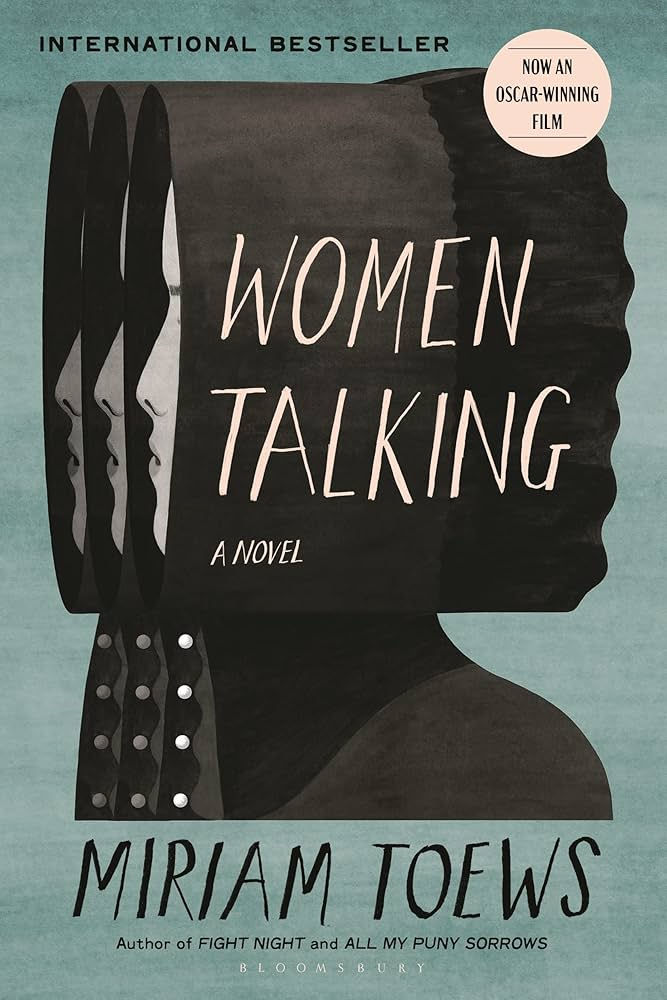
The novel that came out of that obligation was Women Talking. Published in 2018, Toews describes her work as "an imagined response" to the crimes suffered by the women in Bolivia. Set in a fictional colony, eight women gather together in a hayloft during the aftermath of the horrific true events. The men have left the colony, giving the women only twenty-four hours to decide if they can Do Nothing (and therefore forgive the men and go to heaven), Stay and Fight (and be excommunicated and damned to hell if they lose), or Leave the colony entirely (and definitely go to hell, according to the leaders of the colony). The women must reckon with pacifism and forgiveness, the central tenets of their faith, and how those interact with the crimes they have suffered.
Toews writes the narrative through the perspective of August Epp, the colony school-teacher and the only male who is able to witness the discussions these women have. The women are illiterate, having had very little education, so August takes the minutes of the meeting. The novel is told through these minutes. The ony way the reader can learn about these women is through August's voice. The point is clear: the only way for these women to be heard is through a man's voice rather than their own.
Throughout the novel, the women--a group of grandmothers, mothers, and teenagers alike--discuss how compliant they have been for their entire lives. The men have wanted power and the women have learned to be docile in response. Taught not to ask for anything other than what is absolutely necessary, these women spend the book processing their experiences in real time, all while attempting to answer the main question: should they stay or should they go? When one woman suggests they ask the men to leave, the eldest, Agata, responds with:
"None of us have ever asked the men for anything. Not a single thing, not even for the salt to be passed, not even for a penny or a moment alone or to take the washing in or to open a curtain or to go easy on the small yearlings or to put your hand on the small of my back as I try, again, for the twelfth or thirteenth time, to push a baby out of my body. Isn’t it interesting, that the one and only request we Women would have of the men would be to leave?" (Women Talking, Toews).
This leads the women to burst into uncontrollable laughter--the kind of laughter that happens when the only other option is to burst into tears. The women bond through their laughter and their conversations. Despite being illiterate, these women prove that education is not what makes someone able to think. For the first time in their lives, these women allow each other to think, to have a voice, to express themselves. Despite not being allowed to read the Bible, these women are able to learn it and quote it consistently. These women are much more powerful than the men take them for.
When they finally decide to leave, they count on the men's belief that the women will not take any drastic action. They know that the men are blind to how strong the women are. Towards the end of the novel, the elderly farmer who owns the hayloft that the women are meeting in comes in and jokingly asks if the women are plotting to burn down his barn. Agata responds with "No, Ernie. There’s no plot, we’re only women talking.”
And within that line is exactly what these women have to rely on: men underestimating them. The women are simply talking, but that talking in itself is action. All these women can do is talk, and eventually, leave.
Published two years after #MeToo began, Women Talking forced the world to examine women of all religions and lifestyles who have been abused over and over again. When it was first published, Margaret Atwood, renowned author of The Handmaid's Tale tweeted "Don’t miss this one! …Could be right out of The Handmaid’s Tale” (The Guardian).
Women Talking is not a dystopian tale though. Instead, it is, in Toews' own words, “both a reaction through fiction to these true-life events, and an act of female imagination” (Women Talking).


Comments